Monday, 8 June 2009

We trust family and friends more than strangers

It may come as a surprise to some, but a recent study by Mintel revealed that online recommendations from "virtual" friends is the second most accepted form of advice for making a brand decision. As you would expect, family and friends ranked as number one.

If you are a digital marketer this is very encouraging. However, as they say, the devil is in the detail. A closer look at this study provides some interesting details.

According to this study of consumers making brand decisions:

34% look to friends and family
25% ask their spouse (not quite family I guess)
5% use online friends

So even though online recommendations is the second most accepted source for brand decisions it still only represents 5%! That is very low. If online recommendations in the form of social media, blogs, forums and other consumer feedback is largely ignored 95% of the time where does this put TV, print, radio and other forms of advertising? Well, I have a thought on that.

The path that most of us take in making a decision to buy is usually not a snap one. It is usually a process of research and talking it over. The more important (more money) the more time we put into making our decisions. That influence which nudges us one direction or another at the final moment is most often from family and friends. However, before that final decision was made such influences as social media, TV, print and radio all played a role in helping us to do two things:

  • Learn that we needed something
  • Learn what it was that we needed
To summarize: Traditional advertising will be here for a very long time. Social media is very real, and as always, we trust the people we know more than those we don't.

Much success,

Doug

Tuesday, 2 June 2009

Hong Kong My "Real" Home

Today's blog was supposed to be about something quite different. But yesterday something very significant happened to me. This and some dramatic events of the last week, made me feel compelled to write about the effect these have had. The two events are my application for permanent residency and the other is the controversy set off by a series of videos my company marketed for a local hotel chain.


Recently I passed my 7 year mark in Hong Kong. For those that don't know, this is the time a person can apply for their permanent residency which provides a life time visa and more importantly a sense of belonging. I had looked forward to this day from the moment I had first stepped foot in Hong Kong more than 7 years past and with it came a flood of memories.

By many accounts Hong Kong is an unlikely city for me to live. I grew up in the Pacific Northwest with cold winters and dry summers. Hong Kong humidity makes me sweat so much and I wonder if I will ever adjust. Try as I may, I have never managed more than a few words of Cantonese, and over crowded places tend to make me uncomfortable; preferring the quiet of my small Sheung wan flat to the bustling streets. So what is it that made me want to stay?

It is all those things and more. It is the uniqueness of Hong Kong that makes me want to stay. And, arguably, it is what makes others want to come as well and quickly fall in love with this city; opposites attract? I don't know, but I do know that if I wanted sameness I may never have had left the US. Whereas shopping malls, high end restaurants and luxury shops maybe the mark of a good city, and Hong Kong has clearly won this race, those things can be found in most places. So what compels a person to choose one destination over another to visit? Partly it is the familiar but mostly it is for that something different, something special. What makes a person choose one place over another as their home? That is connection.

I remember the big lunch I was taken too when I arrived in Hong Kong. It is the long running tradition and joke, repeated over and over that the new Westerner gets taken to Dim Sum. Inevitably the chicken feet arrive. The Hong Kong hosts chide and smile while the guest shows shock. For my initiation the shock was on my Host's faces when I stuffed one in my mouth easy as you please. Not my favourite Hong Kong cuisine, but can't get that back home for sure.

Language is seldom a barrier in Hong Kong, less so than in some other English speaking countries. My most flabbergasting experience was during a trip to the U.K. While trying to buy tickets to the theatre, the language barrier of a common language was so frustrating for us both that the sales person ended up presenting a printed list of times and prices to short cut the embarrassing exchange. In Hong Kong I still often face issues with language, but in a different way. For those of us that do not speak Cantonese and those that do not speak English a second language has emerged. Simple sentences, gestures, smiles, patience and on rare occasion a reach for the mobile to call a helpful interpreter. Hong Kong has held strong to its unique and ever evolving Cantonese language, even when English was dominant in the governing class. Hong Kong has adapted to accommodate those that find Cantonese undecipherable and that some say you need to be born to in order to speak. So even when I listen to Cantonese and understand all most nothing at all, I realise I maybe separated by a language but not a language barrier.


I highlighted these two experiences because they were the focus of the two videos mentioned earlier. There are four videos in total, but only two were released. The videos received warm to neutral reviews for three weeks. Over 50,000 views and no negative comments. But when it was suggested that the videos portrayed Hong Kong and its people in a bad light some strong, but isolated, negativity started to emerge. The possibility of negative interpretation is not lost on me, but I see if very different. The real situations shown were ones I have lived through and can be seen repeated every day. Real people, real culture, rich and alive, intriguing and inviting. Tourists stream up and down the side streets every day looking at things they would never see at home. Some jump in and others maintain a distance, but they take pictures and, I would imagine, smile when they tell their friends. These videos showed a reality that is seldom seen in Hong Kong promotion. When you pull back the faux facade of the picture postcard-esque promotional campaigns usually associated with Hong Kong what lies below is the real essence of Hong Kong; the people and its culture. Hong Kong has strongly protected it culture and selected the best of the West to build a modern city steeped in long standing traditions. These make the real stories that are remembered and told over and over long after the memory of the generic luxury shop indistinguishable hotel room has faded.

So what is the point of this winding blog post? It is that I came to, and fell in love with Hong Kong, like I believe so many others do, not because of the picture perfect promotional campaigns but because Hong Kong is a real and vibrant city full of contrasts and culture at every turn. So after 7 years I wrote and signed to the Immigration department that

"I have, do and will consider Hong Kong to be my only place of residence".

Signed:

Douglas White

Monday, 25 May 2009

Twitter: are we smarter or dumber?

Recently Thomas Crampton wrote on Twitter that he was giving his interns at Ogilvy a Twitter test. He received some interesting comments, most negative, but mine was in the affirmative and I would like to explain why using more than 140 characters.
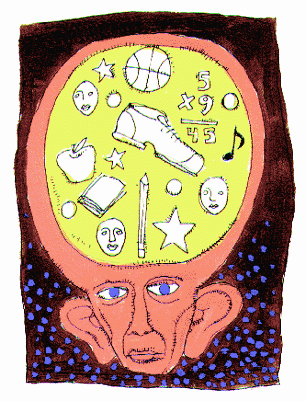
I had been thinking for sometime what this hyper abbreviated world we live in has done to our mental capacity. Are we dumber, as some think, because of our short attention spans or are we becoming super speed human computers? This is worth a brief moment to explore.

Our not too distant past:

Not so long ago we received our information in regularly scheduled, carefully packaged, and formatted requiring no action or response. The average person may have read the morning paper, listened to a bit of radio and tuned into the 6 o'clock news. It didn't matter what channel -- it was all the same news. During the day there were few interruptions because of no mobiles, email, faxes, msn, social sites or other such distractions. A nice leisurely pace to quietly digest a bland diet of well processed news and information. It is not a stretch to think that you would require a long attention span just to keep from going CRAZY! Imagine having no stimulus coming in between the morning paper and the evening news.

Today:

The average person probably now processes more information in an hour than a person just a short time back did in a week? year? lifetime? Using myself as an example, I receive several hundred emails every day, maintain several msn conversations, read 30 news feed, manage a team of 11 people, check out what my colleagues are doing on Linkedin twice per day, comment and giggle at new posts on Facebook at least 3 times a day, spend more than one hour a day researching online for business and a bit more for fun stuff to do after and watch a stream of twitter messages. This is only a portion of what passes my, or your, eyes and ears on any given day. It starts to become more clear that the appearance of a short attention span is, in fact, really a finely tuned brain that is able to process volumes of data, sift at lightening speed, and make quick and concise decisions with out missing a keystroke.

So how does this pertain to a Twitter test?

I could summarise most of my high school and university education in one concise Tweet. What I quickly learned in high school and University was that there were always enough, if not too many, facts around. Research was the easy part so keeping stuff in your brain did not make a lot of sense. It was always just a short reach away. What was valuable was being able to organise and communicate these facts.

  • Context -- relevant to conversation
  • Continuity -- maintain the thread
  • Concise and well formed -- 100 characters
  • Syntax correct @,#, DM, RT,
  • Correct references included (tinyurl)
  • Correctly sited (@douglaswhite)

Monday, 18 May 2009

YouTube a distant 3rd: Behind Facebook and MySpace

Surprised! Not really. Last week I wrote a blog, Social Sites a whimper or a Yell!, on the 3 stages that a social site must go through to be successful and not linger or fail. I pegged YouTube as having failed to successfully reach the third stage. This week Hitwise released data confirming my theory. I find no satisfaction in being right on this point. YouTube is a hero in my book. This application revolutionised communication by allowing free and unlimited sharing of videos. The world opened up in a way never before imagined. This was not a "me to" application, but a real revolution. But that said, if it wasn't for the deep pockets of Google it may not be around today. Why?


The 3rd important stage a viable social media/network site must evolve into is "Strong and Stable". This is recognised as the phase where the social site adds value to the end user and through this enjoys a stable user base and is able to generate revenue through channels aligned with the sites business model. There is no question that YouTube is widely used. YouTube videos can be seen everywhere. It is currently estimated that 67% of online videos streamed are through YouTube. But what does this really mean? It all seems OK but is it really?

The difficulty with YouTube is that it lacks functionality that bring people in and holds them. It is my guess that we all view more YouTube videos on Facebook or embedded on other websites than on YouTube itself. There are few, if any, functions on YouTube that make it an enjoyable experience for anyone other than those posting and managing their videos. So how does a site with enormous infrastructure costs that are disproportionate to their member numbers survive. This is the conundrum for YouTube. Whereas, Facebook and MySpace have evolved to make their sites a destination, YouTube seems to being moving further away from this target goal while providing no revenue stream to fill the gap. At this point I could paint a disappointing picture that YouTube will fall back on old school tactics of forced in-video advertising and possibly paid hosting. I hope they arrive at a more innovative and less intrusive solution, but I am not optimistic. In the mean time I assume they will continue to reach ever deeper into Google's pockets.

Saturday, 9 May 2009

Social Sites: A whimper or a YELL!


YouTube, Facebook and Twitter. All are in the press these days and if they are not part of our lives yet they probably soon will be. So how do they fare when judged against "what makes a successful social site"? Let's have a read:


Social sites have been around for some time now. And in that time I have had a chance to observe some fairly standard activity that either leads to success or obscurity for social sites. Keeping things simple, there are 3 phases that a social site needs to survive and there are 3 groups of people that will help to make or break it.

Phases:

  1. Fad and Frenzy -- everybody jumps on board. Vampire bites and hours of endless surfing with no real point or reason. This is a very important phase for a social site.
  2. Get Real -- Rapid fall off of people as they realise that they are completely wasting their time on what seems to be a senseless and all consuming past time. Use and tools need to get sophisticated to retain interest.
  3. Strong and Stable -- Innovation leads to value. People recognise useful tools and ability to make time work for them and not take time from them.

Groups:

  1. Time wasters -- These are usually the first on an application and the last to leave. With hours of endless time to waste, they are usually the ones that push the next group off because of persistent annoying behaviour.
  2. Convince me -- These are the people that tentatively join after a bit of coaxing but do not get caught up in the craziness and drop off quickly. However, these are the core group that will return if the app makes it to the 3rd phase.
  3. Innovators -- These are the people that see the future. They transcend the silliness and ego that drives social sites in the first two phases and can recognise the long term potential. They develop the apps that turn a "waste time" app into a valuable tool.

Three very well know social media apps are YouTube, Facebook and the up and coming Twitter. Each of these represents various stages of the 3 phases.


YouTube (no success yet) was the most promising. With its explosive launch and unique offering – VIDEO, YouTube set the world ablaze with imagination. YouTube provided us with a new world of choices, new ways to share and hours of good fun. YouTube enjoyed one of the most explosive Fad phases of any social media application to date. However, since that time they have not been able to transition to the Strong and Stable phase. YouTube has not come up with a solid business model that provides long term profitability. My comment to my clients is that YouTube is a good platform for them to host their videos free of charge. But it is lacking as a good marketing tool and their poor search capability and overwhelming amount of content makes it almost impossible to use with out additional help outside YouTube. Without the deep pockets of Google supporting YouTube they most likely would not be able to continue. The cost of supporting their services is too prohibitive without a legitimate revenue model.


Facebook, despite the occasional bad press, is a poster child for success. It grew at meteoric speed and then faced intense pressure to retain viewers. Exhausted by vampire bites and inane gifts, the “convince me” group started to leave in droves. What made Facebook greatly successful is that the Innovators were able to see long term value in the deep connections that Facebook allowed. This ability to manage connections whether they are friends, events, social media or virtually any other had huge value. Facebook matured into a good personal management systems. With its attention to small business and organisations, it opened itself up to limitless content creation. The ability for individuals to filter and minimise unwanted communications makes it very attractive. It is almost impossible to eliminate spam from your email, but with Facebook you only see what you want.


Twitter is the up and coming new Social App. The hype is huge and people are logging on and jumping off in droves. However, the innovators have clearly identified Twitter as possessing great potential. The question is will Twitter successfully make it through the final Strong and Stable phase? I am betting it will.